


Project Leader: Bizhanova Nazerke
Implementation period: 2023–2025
IRN: AP19680227
Relevance
The negative impact of linear structures on animal populations has now become a global problem. The intensive development of Central Asian countries, the expansion of trade between China and Europe, and the exploitation of mineral deposits necessitate the construction of roads, railways, and other infrastructure. These transport lines cross traditional migration routes, disrupt migration patterns, divide habitats, and often lead to the direct death of animals. In recent years, Kazakhstan has been intensively constructing and designing new highways and railways that intersect animal migration routes. Of particular concern is their impact on saiga (Saiga tatarica) populations—a widespread and valuable ungulate species that regularly migrates long distances. This project, for the first time, examined the impact of rail and road infrastructure on saiga behavior at different population levels and along animal migration routes. The effectiveness of existing crossings was assessed, and optimal design options for crossing railway lines were proposed.
The aim of the project:
To assess and forecast the impact of existing and planned transport lines and associated infrastructure on saiga populations and develop recommendations to reduce or prevent harm to animals.
Project objectives:
- Conduct an analysis of the location of existing and planned roads and railways, and identify highways that cross, or will cross, migratory routes of saigas.
- Determine the scale of the reduction in the saiga range that has occurred as a result of the construction of highways.
- Conduct ground, aero-visual and satellite tracking of saigas during spring and autumn migrations in order to identify possible road intersections and the optimal locations and arrangement of crossings for animals.
- Assess the scale of saiga mortality on roads and railways and identify problem areas along existing transport lines.
- Evaluate the effectiveness of the constructed earth crossings for animals through the new highways in Ustyurt and in Central Kazakhstan.
- Explore the possibility of constructing bypass routes (when designing new roads) in some key habitat areas, in order to avoid damage to saiga populations.
- Develop recommendations to reduce or prevent the negative impact of roads and railways on saiga populations.
Project performers:
Scientific supervisor of the project:
Nazerke Bizhanova, PhD, Senior Researcher at the Laboratory of Theriology, ORCID ID: 0000-0002-1804-2511, Scopus ID: 57874162200
h-index 3
Person in charge:
Grachev Alexey, Acting Head of Laboratory of Theriology, ORCID ID: 0000-0001-6051-8299, Scopus ID: 57873983000
h-index 3
Staff of the Laboratory of Theriology of the Institute of Zoology of the MSHE RK:
- Yerlik Baidavletov, Researcher, ORCID ID: 0000-0001-7708-8002, Scopus ID: 58754829500, h-index 2
- Ryspek Baidavletov, Senior Researcher, ORCID ID: 0000-0002-9551-0040
- Yerlan Tashibayev, Researcher, ORCID ID: 0000-0002-3805-0535
- Altay Zhatkanbayev, Researcher, ORCID ID: 0000-0001-9446-3660
- Saltore Saparbayev, Researcher, ORCID ID: 0000-0001-8410-9289
- Sergey Bespalov, Junior Reseacher, ORCID ID: 0000-0003-2595-4954, Scopus ID: 57873250000 h-index 3
- Maxim Bespalov, Junior Reseacher, ORCID ID: 0000-0002-8947-5162, Scopus ID: 57873435200 h-index 3
- Indira Kumaeva, Junior Reseacher, ORCID ID: 0009-0007-6607-4415
Research results:
Based on the results of research conducted in 2023–2025, the following conclusions were reached:
1. Analysis of our own and departmental data on the road network revealed that the saiga’s migration routes are crossed by a number of major and minor railways and highways. The total length of railways crossing the saiga’s range is 4,021.54 km, and highways are 80,427.556 km.
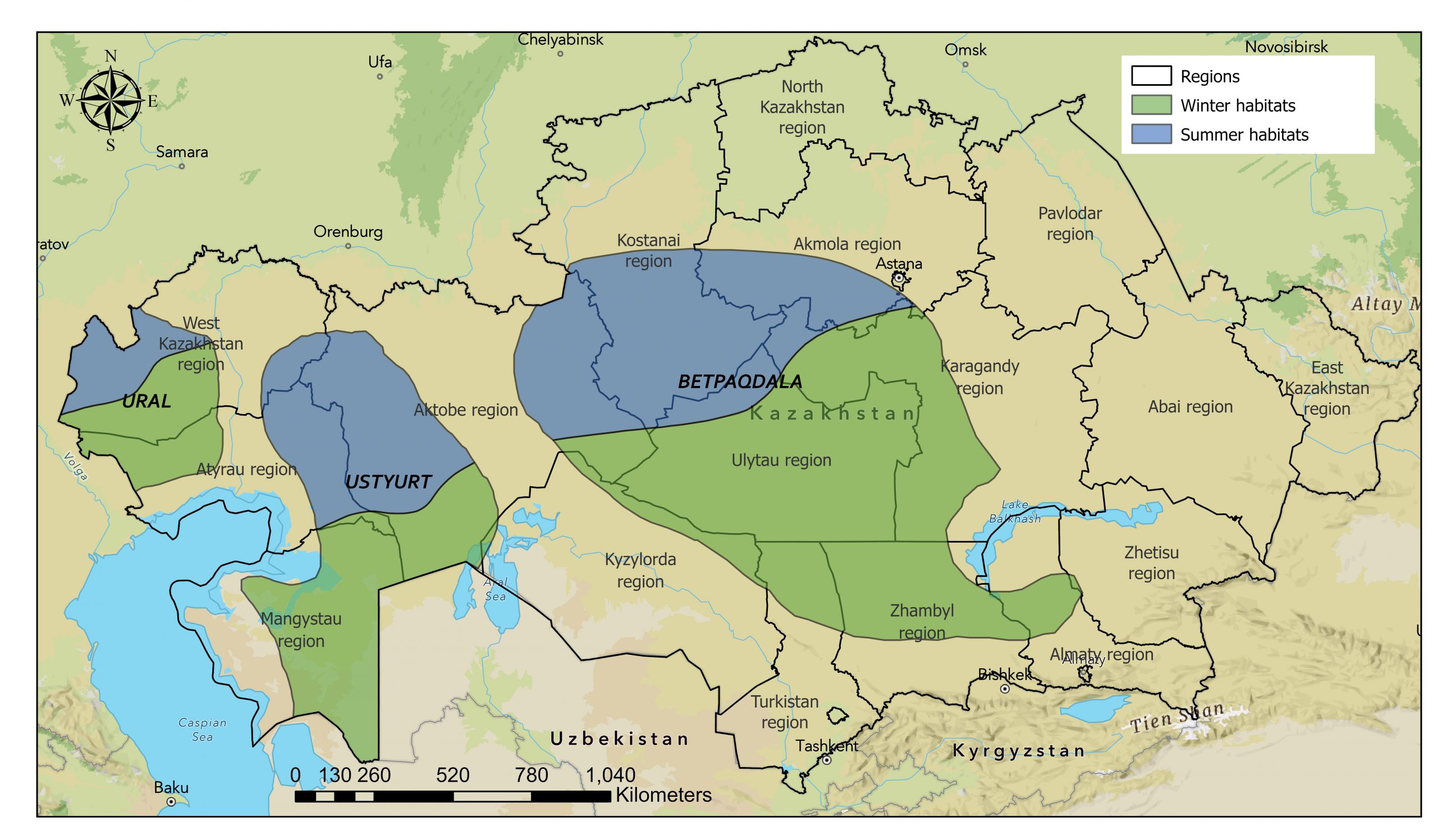
Within the Betpak-Dala population’s range, important migration routes are crossed by the Zharyk–Zhezkazgan railway (443 km long) and the Zhezkazgan–Saksaul railway, built in 2015 (462 km long), as well as the planned section of the Astana–Arkalyk–Torgay–Irgiz highway of the Western Europe–Western China international highway (approximately 1,280 km) and the Kyzylorda–Zhezkazgan–Pavlodar–Uspenka highway (approximately 1,360 km). These highways run latitudinally (from west to east) and cross the entire range of the population. In the meridional direction, the Yesil–Kyzylzhar railway (510 km long) divides the saiga population into separate eastern and western groups. Railway lines crossing the saiga’s winter or summer habitats, such as the Khromtau-Kostanay (198 km), Zhezkazgan-Aibat (130 km), Karagandy-Shu (448 km), Karazhal (70 km), Aksyuek (61 km), Moiynty-Balkhash (31 km), and Inner Zhezkazgan (118 km), have a comparatively lesser negative impact.
In the range of the Ustyurt population, important migration routes are crossed by the Shalkar–Beineu railway (440 km), built in 2015, and the Atyrau–Kandagash railway (482 km), which has been in operation since Soviet times. The Beineu–Aktau (280 km) and Makat–Turkmenabat (434 km) railways, which cross the southwestern and westernmost parts of the range, respectively, have a significantly lesser negative impact.
In the Ural population’s range, the linear transport infrastructure includes roads running in a latitudinal direction: Chapayev–Kaztalovka–Zhanibek (approximately 350 km) and Chapayev–Zhanakala–Saykhin (approximately 420 km). Among the railway lines, the westernmost part of the range is crossed by the Saratov-Astrakhan railway (137 km), but its impact on saiga migrations is minimal.
2. Analysis of retrospective and current data showed that the historical reduction of the saiga range occurred as a result of mass mortality during jute winters (in the mid-19th century, in the Volga-Ural interfluve), as a result of mass poaching (in the 1990s, throughout Kazakhstan), as a result of mass mortality from a pasteurellosis epizootic (in 2015 in the Betpak-Dala population in Central Kazakhstan), and as a result of the development of linear infrastructure.
An analysis of long-term migrations showed that the maximum length of saiga migration routes in the Betpak-Dala population previously reached 1,200 km, in the Ustyurt population – 600 km (including into Uzbekistan), and in the Ural population – 300 km.
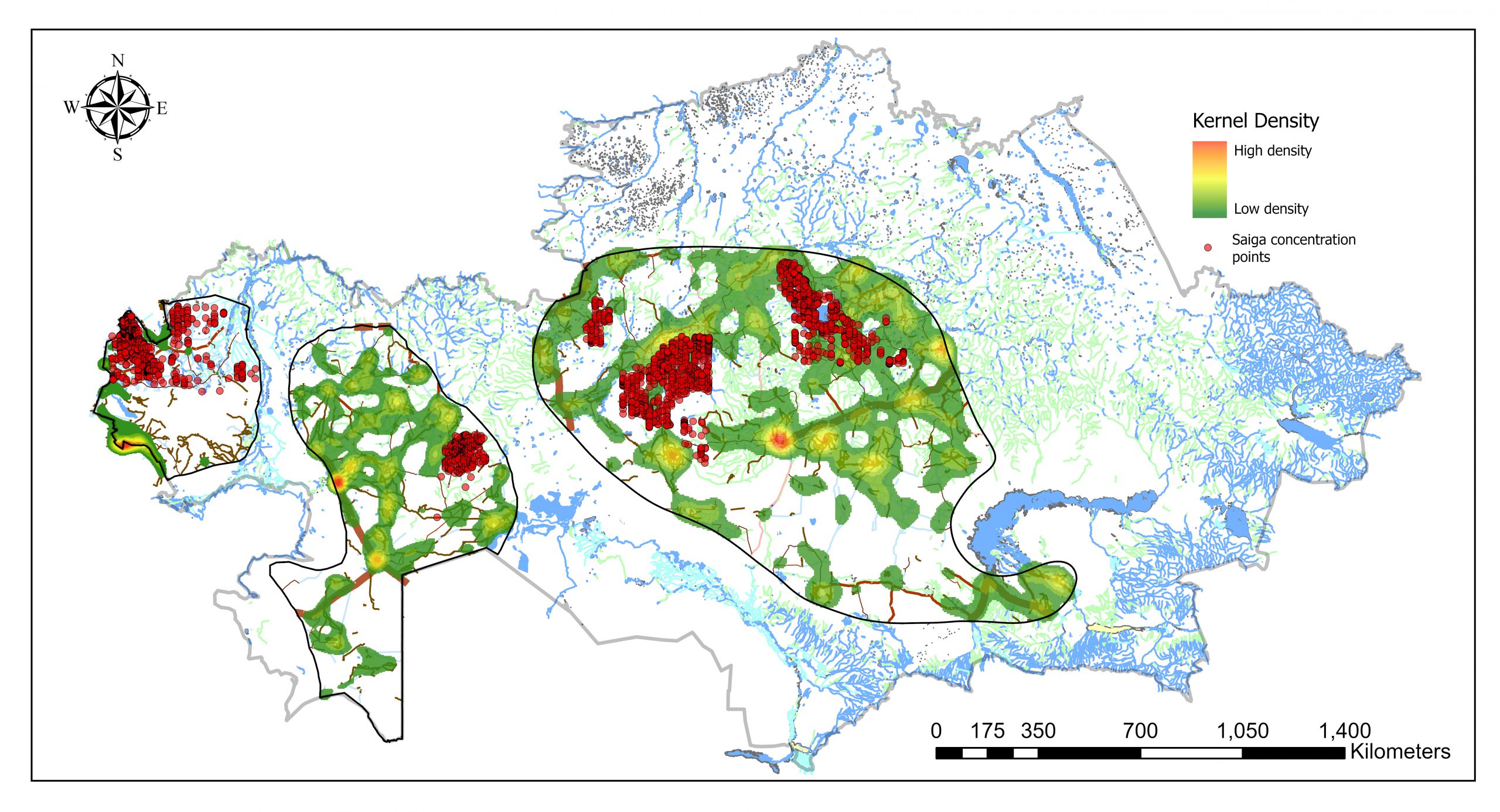
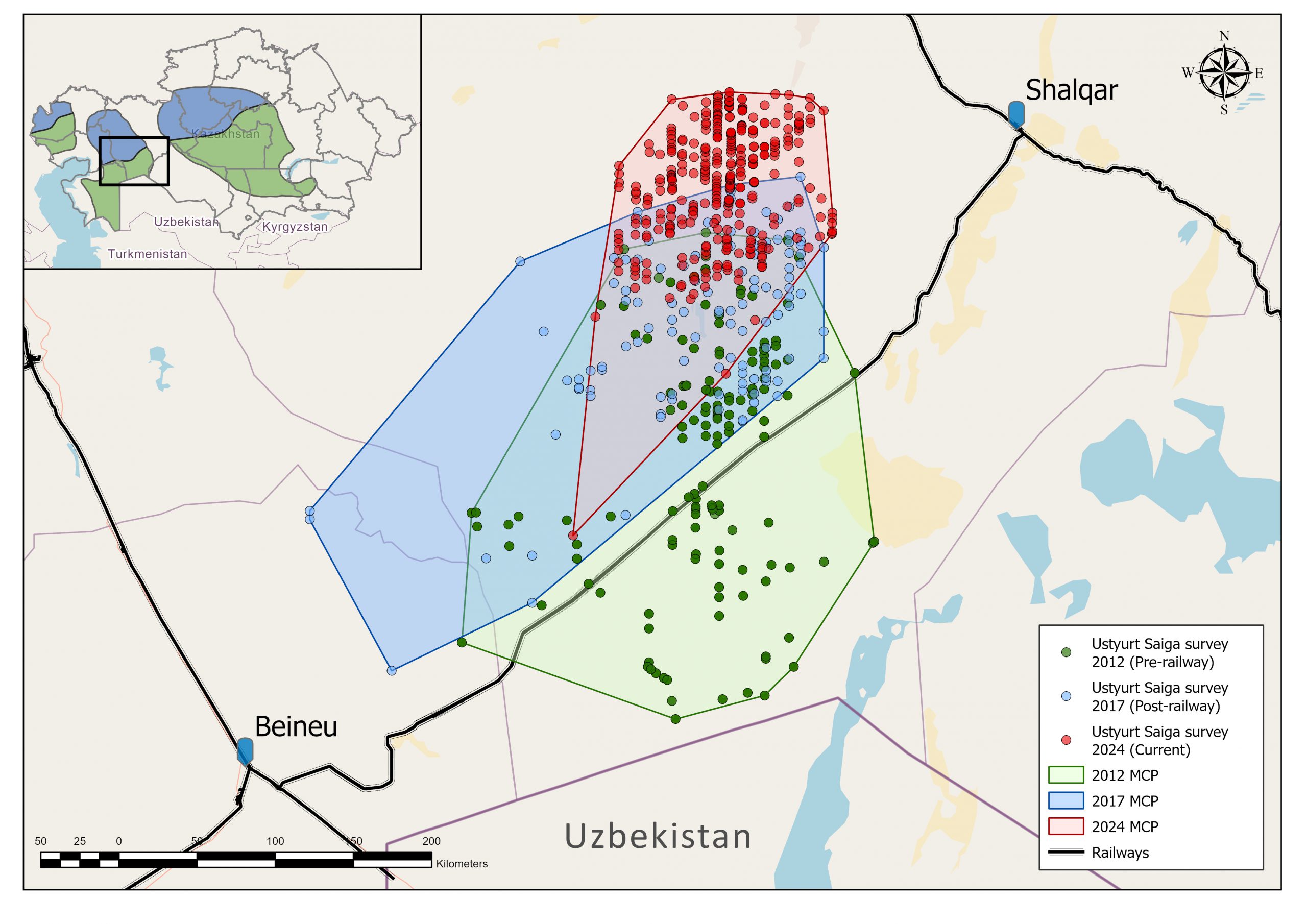
Kernel density and minimum convex polygon analysis using field, road, and rail data overlaid on a GIS revealed a negative relationship between infrastructure density and saiga population frequency. This is particularly pronounced in the Betpak-Dala and Ustyurt populations, where high rail infrastructure density (0.342 km/100 km² and 0.55 km/100 km², respectively) coincides with a sharp decline in migratory activity and saiga aggregation in areas weakly affected by transport infrastructure. The Ustyurt population, meanwhile, has seen a 79.84% reduction in its winter range since 2015, from 157,912.61 km² to 31,834.57 km². Major railways, such as the Saksaul-Zhezkazgan, Zhezkazgan-Zharyk, and Shalkar-Beineu railways, cross key migration routes and have contributed to a significant reduction in range, isolation of subpopulations, and a northward shift of seasonal saiga habitats. In contrast, the Ural population, with minimal impact from railway infrastructure (density 0.128 km/100 km²), has demonstrated a steady demographic recovery. Despite its wider distribution, The removal of roads is less pronounced due to their greater traffic volume. However, projects such as the Western Europe–Western China Transit Corridor and the Center–West Regional Development Corridor should be accompanied by a detailed assessment of their intersections with the migration routes of saigas and other animals.
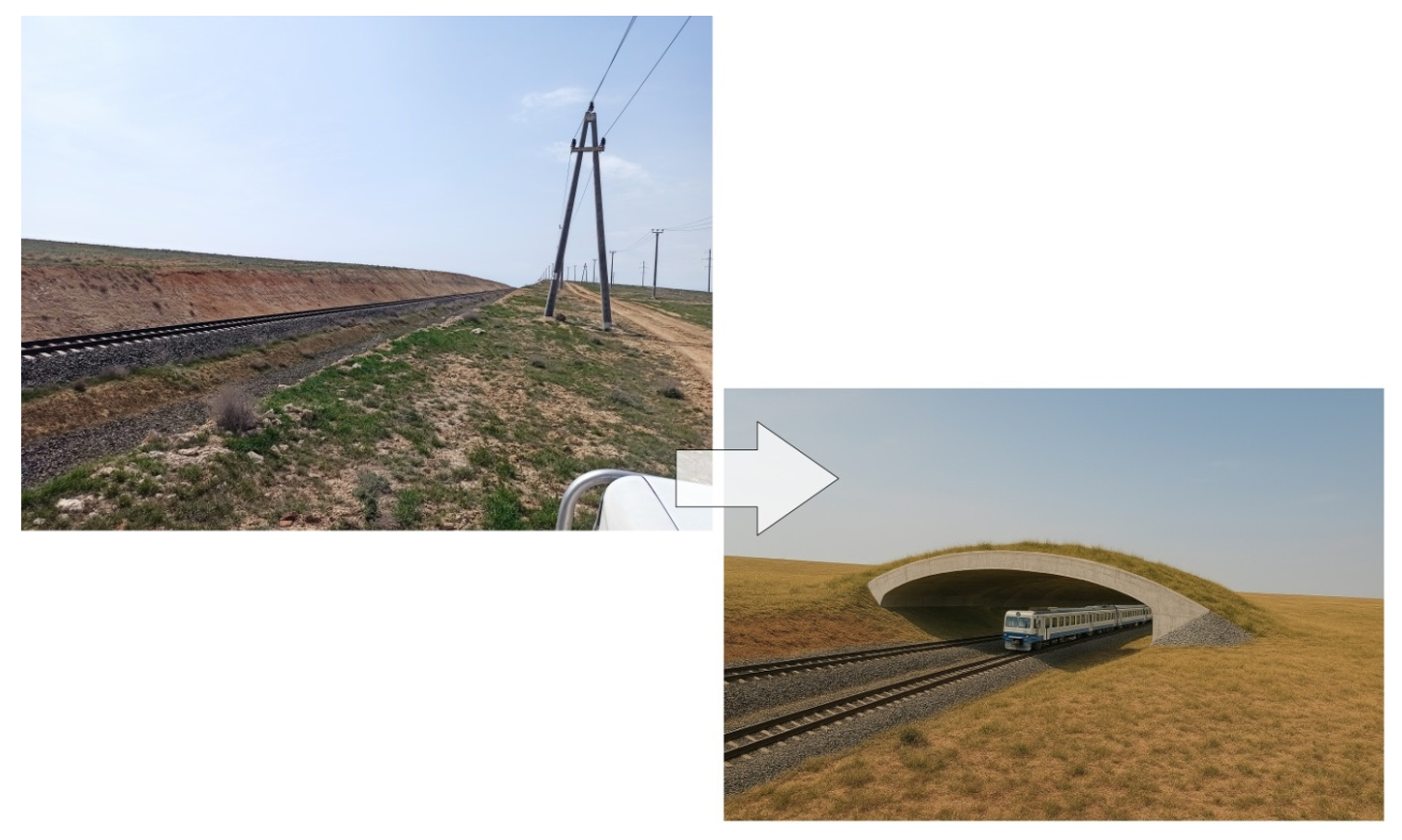
3. Systematic monitoring of saiga behavior using camera traps near artificial crossings over railway embankments on the Zhezkazgan–Saksaulskaya (Central Kazakhstan) and Shalkar–Beineu (Ustyurt) sections revealed that saigas rarely use these crossings on the Ustyurt (Shalkar–Beineu railway). In Central Kazakhstan, numerous approaches by animals to the crossing zone were recorded on the Zhezkazgan–Saksaulskaya railway, but crossing attempts were isolated. The conducted work confirms the ineffectiveness of the current saiga crossing structures. To restore migration routes, two sites were identified for the construction of a new type of structure—animal overpasses at least 50 meters wide and approximately 1 kilometer long. The first site has geographic coordinates: N45°55’08.5652″; E56°55’30.5853″; the second is N45°56’53.4537″; E56°59’19.3527″.
4. A survey of regions with high saiga populations (Ulytau, Aktobe, Kyzylorda, Mangistau, and Karaganda regions) revealed that saigas continue to cross most modern roads without fences, especially during migration periods. However, speed and traffic flow increase the risks. Saigas often avoid areas with fences, but in April 2025, a small group of saigas died during their spring migration due to newly installed fences along the Zharyk–Zhezkazgan railway.
According to departmental reports and surveys conducted in the railway and environmental sectors, mass deaths of saigas due to collisions with trains have been periodically recorded in recent years. The most recent incident was recorded in January 2024 on the Shubarkol-Kyzylzhar railway in the Ulytau district, where 25 saigas were struck by a diesel locomotive and died.
Similar to fatalities on railway tracks, newborn calves and young saigas are particularly vulnerable on highways and secondary roads. During research conducted in May 2024, during the calving season, 11 saiga calf deaths caused by vehicle accidents were recorded on dirt roads in Western Kazakhstan.
5. Recommendations were made to reduce or prevent the negative impact of roads and railways on saiga populations:
– Construction of overpasses on all newly constructed railways and roads crossing migration routes, 1 km long, with gentle slopes and no vertical elements;
– Modification of existing overpasses taking into account saiga visual perception – removal of poles, use of vegetation;
– Bypass design principle – when laying new routes, routes should be planned taking into account migration route maps, preferably outside the core wintering and calving zones;
– Regular monitoring using camera traps and aerial surveys to assess the use of overpasses;
– Temporary speed restrictions for vehicles during lambing season and mass migrations (April-May, October-November) in areas with high animal densities;
– Environmental education for drivers and local authorities on the importance of migrations and the safety of wild animals.
The project’s results and recommendations for reducing or preventing the negative impact of roads and railways on saiga populations were presented to the Ministry of Ecology and Natural Resources at a special meeting dedicated to the saiga issue, chaired by Minister of Ecology and Natural Resources E.N. Nysanbaev.
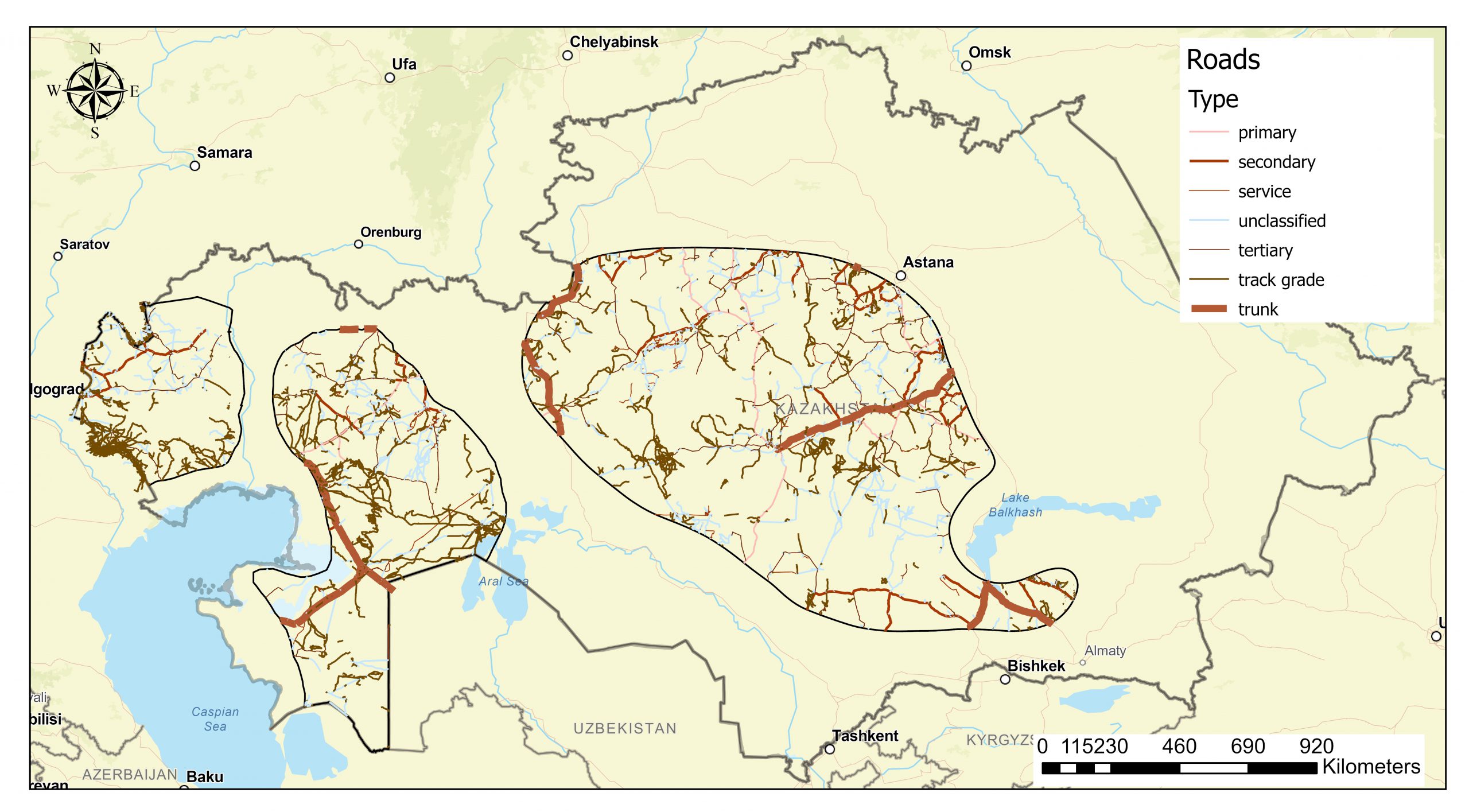
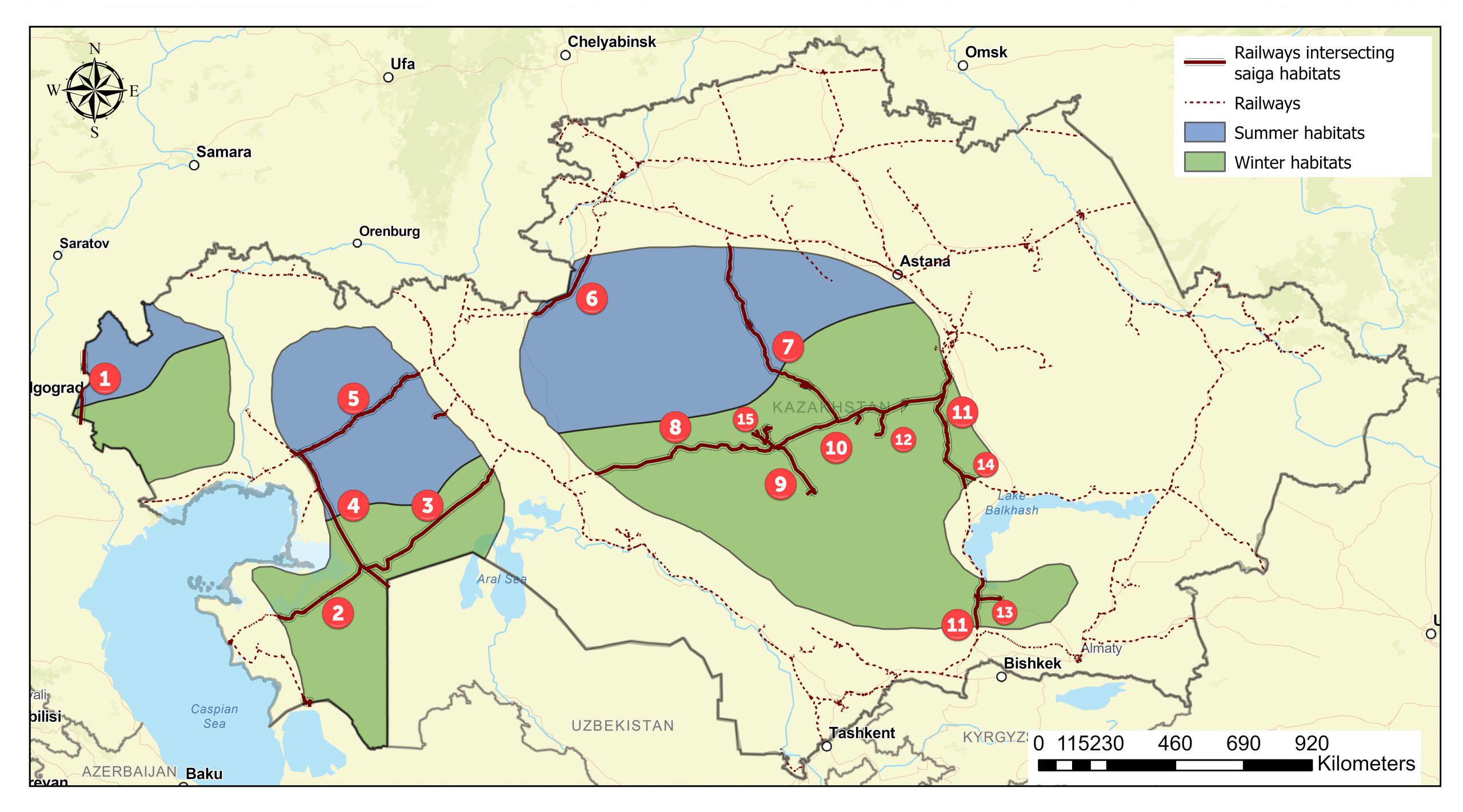
Note: The area of the Ural population: 1 – Saratov–Astrakhan. The area of the Ustyurt population: 2 – Beineu–Aktau, 3 – Beineu–Shalkar , 4 – Makat–Turkmenabad and 5 – Kandyagash–Atyrau. The area of the Betpakdala population: 6 – Khromtau–Kostanay, 7 – Yesil–Kyzylzhar, 8 – Zhezkazgan–Saksaulskaya, 9 – Zhezkazgan–Aybat , 10 – Zharyk–Zhezkazgan, 11 – Karaganda–Shu, 12 – Karazhal, 13 – Aksuek, 14 – Moyynty–Balkhash and 15 – Zhezkazgan internal. Summer habitats (blue), winter habitats (green).
The research results were summarized in six scientific papers, including two articles in journals included in Scopus and/or Web of Science (Q1, Q2), two articles in journals approved by Science and Higher Education Quality Assurance Committee, and two works – in conference proceedings.
List of published papers:
Articles in top-ranked journals included in the WoS and/or Scopus databases:
- Bizhanova N., Grachev A., Rametov N., Baidavletov Y., Saparbayev S., Bespalov M., Bespalov S., Kumayeva I., Toishibekov Y., Khamchukova A., Grachev Y. Railway and Road Infrastructure in Saiga Antelope Range in Kazakhstan // Diversity. – 2025. – Vol. 17. – No. 6. – P. 431 (Q2, Scopus 77%). https://doi.org/10.3390/d17060431 (In English)
- Khamchukova A., Duysebayeva T., Gillani Q.F., Jamali M.A., Kumayeva I., Zhazitova M., Saparbayev S., Bespalov M., Bespalov S., Grachev A., Baidavletov Y., Bizhanova N. Current States of Bridge Construction Materials for Wildlife Crossings in Linear Infrastructure for Saiga Conservation: A Review // ES Energy & Environment. – 2025. – Vol. 30. – P. ee1974 (Scopus 82%). https://dx.doi.org/10.30919/ee1974 (In English)
Articles in journals included in the KOKSNVO database:
- Begilov T.Z., Bizhanova N.A., Yeszhanov B.E., Sarsenova B.B. The current ecological state of the Volga-Ural saiga population and the problems of sustainable development of the population // Eurasian Journal of Ecology. – 2024. – Vol. 80. – No. 3. – P. 56-67. https://doi.org/10.26577/EJE.2024.v80.i3-06 (In Kazakh)
- Bizhanova N.A., Oleinikov A.Yu., Kantarbayev S.S., Grachev A.A. Mammals of the Kazakh part of Irtysh River region: ecosystem services, economic importance and anthropogenic disturbance // Experimental Biology. – 2025. – No. 2 (103). – P. 105–124. https://doi.org/10.26577/bb202510329 (In Russian)
Conference materials:
- Grachev Yu., Bizhanova N., Grachev A. Linear transport infrastructure in saiga antelope (Saiga tatarica) habitats in Kazakhstan // 2nd International Conference on Electrical and Power Engineering ICPE-CA “ASMES 2024: Advanced structures, materials and electrical systems”, Tulcea, Romania, 2024, pp. 47–48. (In English)
- Grachev A., Bizhanova N. Importance of using wildlife crossings over railways in Kazakhstan for saiga conservation // 4th International Symposium on Emerging Materials and Devices, Astana, Kazakhstan, 2025. – 1 p. (In English)