



From January 2026, an Order of the Minister of Ecology and Natural Resources of the Republic of Kazakhstan “On the introduction of a ban on the use of the Central Asian tortoise, its parts and derivatives in the territory of the Republic of Kazakhstan until 2040” (No. 351 of December 18, 2025) came into force.
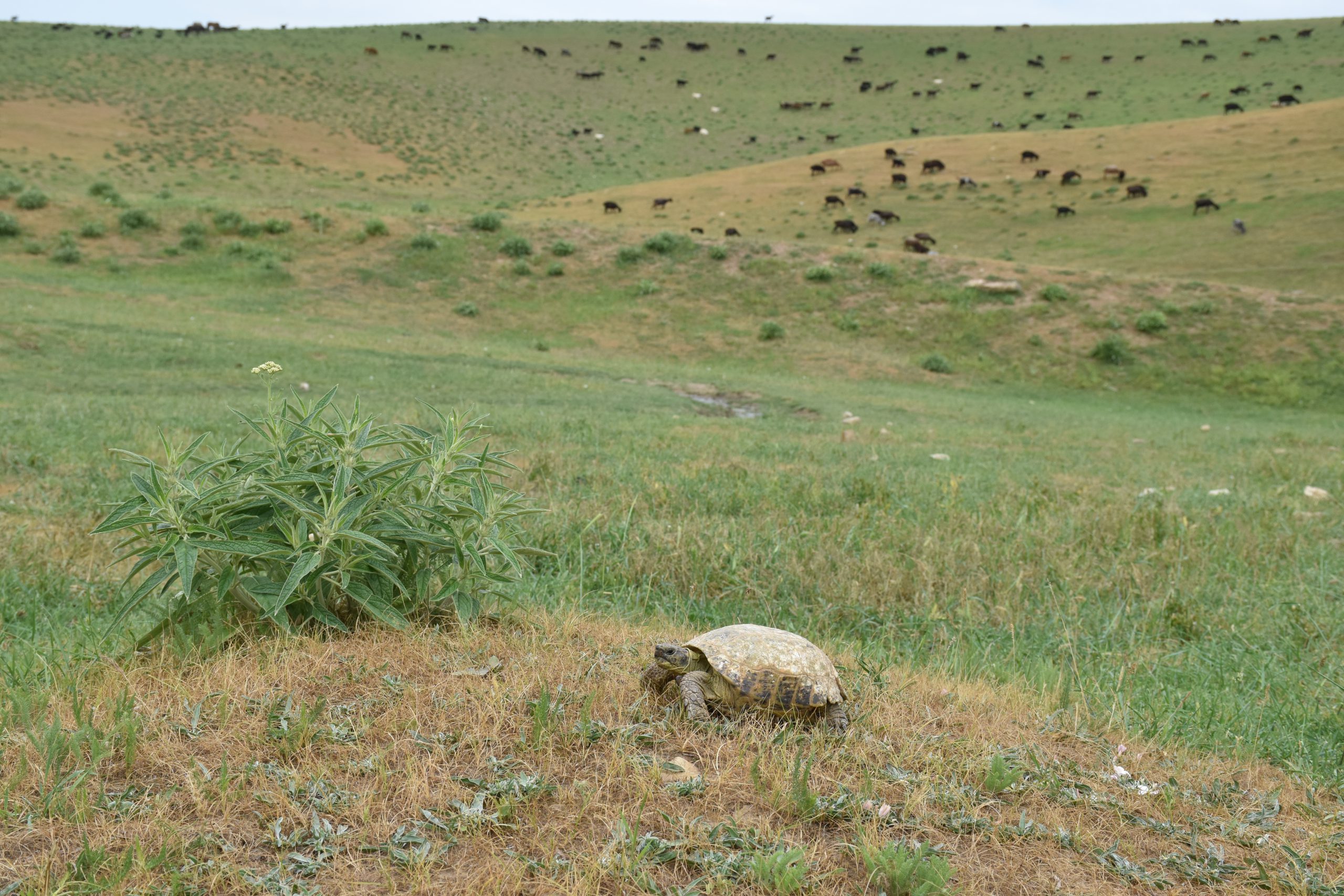
Central Asian tortoise (Testudo horsfieldii), photo by Yu.A. Zima.
This means that throughout the territory of Kazakhstan, the removal of the Central Asian tortoise from the wild, as well as the use of its parts and derivatives for commercial purposes, is prohibited.
The strengthening of protection measures for the Central Asian tortoise was based on a Biological Justification dated March 31, 2025, developed by herpetologists of the Institute of Zoology of the Republic of Kazakhstan. The scientific rationale was based on long-term census data and research results on the state of tortoise populations in different regions of Kazakhstan.
The adoption of this decision became possible due to the cooperation of governmental, scientific and public organizations, with the active participation of the Nature Conservation Fund “Tasbaqa”, which makes a significant contribution to the conservation of the Central Asian tortoise in Kazakhstan, including animal rehabilitation and release into the wild, as well as educational activities.
The Central Asian tortoise is in a very vulnerable condition not only in Kazakhstan, but throughout its entire range. As a result of intensive and uncontrolled harvesting in the 1930s–1990s, tortoise populations in Kazakhstan were severely depleted.
Despite the fact that a ban on the export of tortoises from Kazakhstan has been in place for 25 years, illegal removal from the wild and smuggling across the border continued. In addition, within the domestic market of the Republic of Kazakhstan, tortoises are still being illegally captured from nature without permits and sold.
Populations of the tortoise are also severely affected by the destruction of their habitats, including land ploughing, uncontrolled livestock grazing, annual grass burning by local residents in areas of occurrence, which causes irreparable damage to entire ecosystems, as well as other factors.
The Central Asian tortoise (Testudo horsfieldii) is an ecologically significant species of steppe and semi-desert ecosystems of Kazakhstan and Central Asia, playing a key role in biocenoses within its distribution range.
This species is an important food resource for a number of birds of prey and mammals during their breeding period, including species listed in the Red Data Book of the Republic of Kazakhstan. Uncontrolled harvesting and habitat destruction of the Central Asian tortoise may lead to its complete disappearance in certain areas, which in turn can cause a decline in the reproductive success of predatory birds and mammals and their total disappearance in a given region.
What threatens those who violate the ban?
Illegal handling of rare and endangered species, as well as species prohibited for use, falls under Article 339 of the Criminal Code of the Republic of Kazakhstan.
The following penalties are предусмотрены:
– a fine of up to 3,000 monthly calculation indices (in 2026, one MCI equals 4,325 tenge: 3,000 × 4,325 = 12,975,000 tenge);
– community service for up to 800 hours or imprisonment for up to 3 years;
– confiscation of property and deprivation of the right to engage in certain activities for up to 5 years.
We express our gratitude to everyone whose efforts made it possible to adopt this decision aimed at conserving populations of the Central Asian tortoise in Kazakhstan.
12.01.2026